
Last Updated : Apr 18, 2026 | Author : Tanya Prasad | View Count : 1114 | Read Time : 8 min
Sacred Stories or Misunderstood Indian Myths? Unveiling India’s Cultural Truths
When people hear the term “Indian myths,” they imagine colorful stories with many-armed gods and flying chariots. They find it interesting but assume that it's fictional. This idea is common, but it is not true. What is called “myth” today was never meant to be fiction. These accounts were shared as truth and beliefs, but it is more than that. For over a billion people, even today, they describe them as real history, the universe, and the nature of human life.
The ancient texts of India, like the Vedas, Upanishads, Puranas, and the great epics Ramayana and Mahabharata, are some of the oldest sources of knowledge in the world. They were not written for entertainment. They were carefully developed and passed down by sages and scholars over thousands of years. Every so-called Indian myth in this list comes from a real text, is linked to a real place, or is part of a belief system that people still follow today.
Before you continue, try to set aside the word “Indian myths.” Think of this as ancient knowledge, as it is recorded understanding from a civilization older than Greece and Rome, and still alive today.
Is Indian mythology still relevant in modern times?
Yes, more than most people realise. Indian myths are not just on the page but part of actual history & the country’s belief systems too. It became yoga, it became festivals, it became the way families greet guests and begin new chapters of their lives. Somewhere between ancient wisdom and everyday living, it just never stopped being relevant.
The Trimurti — The Cosmic Trinity
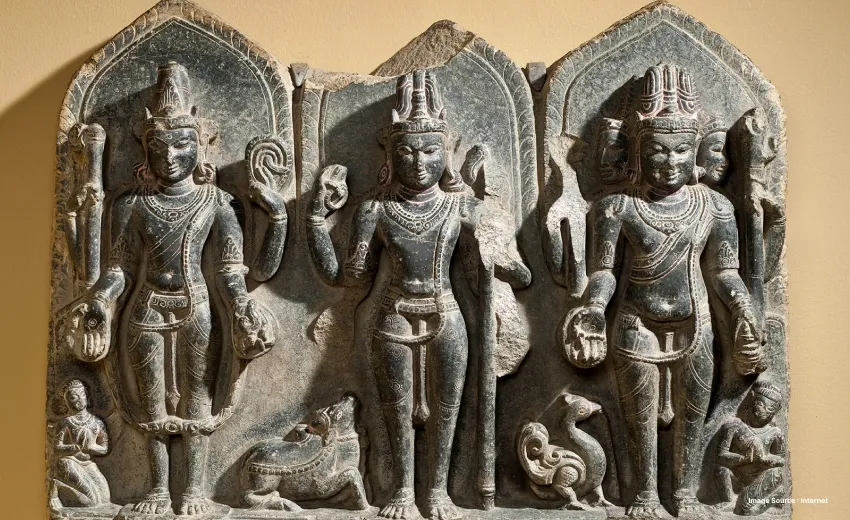
Everything in the universe follows a cycle of three basic steps. Things are created, they are cherished, and then they change or end, and so this Hindu concept of a cosmic trinity frames a universal pattern. Lord Brahma represents creation. He is the originator , the force that brings everything into existence. Lord Vishnu represents balance and protection. He sustains and maintains order in the universe. Lord Shiva represents transformation—the ending that makes space for new creation.
The trimurtis are not separate gods working against each other. They are different forms of one deeper reality. The texts describe them as expressions of Brahman, the one formless consciousness of all existence. This idea shows a clear and structured way of understanding how the universe works.
Amrita — The Nectar of Immortality
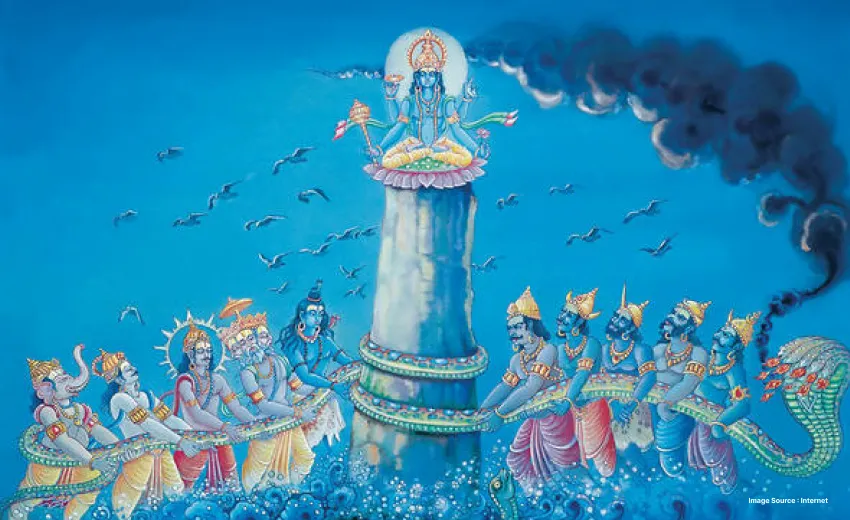
This is one of the most famous events in Hindu cosmology, known as Samudra Manthan (literally "churning of the ocean"), where gods(Devas) and demons(Asuras) worked together to churn a cosmic ocean because neither had the strength to churn alone. It’s a metaphor for how opposing forces sometimes align for a greater cause. They used a mountain as a rod and a giant serpent, Vasuki, the king of serpents, as a rope representing the primal energy being harnessed. As they churned the ocean, many things came out—some good, some dangerous. Among them was Poison (Halahala) — The first thing to emerge was a deadly poison so powerful it threatened to destroy everything, and to save the universe, Lord Shiva drank that poison.
Later came out valuable treasures, and finally,Amrita (nectar of immortality) — The final prize, the whole point of the churning. It only came after everything else had been endured, and it was consumed by the gods.
This account comes from the Bhagavata Purana. It is not just an imaginative story. It explains a simple truth: before reaching something valuable, you often face difficulty. Before peace or clarity, there is struggle. This same event is connected to the Kumbh Mela, the world’s largest gathering. According to belief, drops of Amrita fell at four specific locations on earth during a celestial chase after the churning. Those locations — Prayagraj, Haridwar, Nashik, Ujjain — are where Kumbh Mela is held, in rotation, every few years.
The Dashavatara — Ten Forms of Vishnu
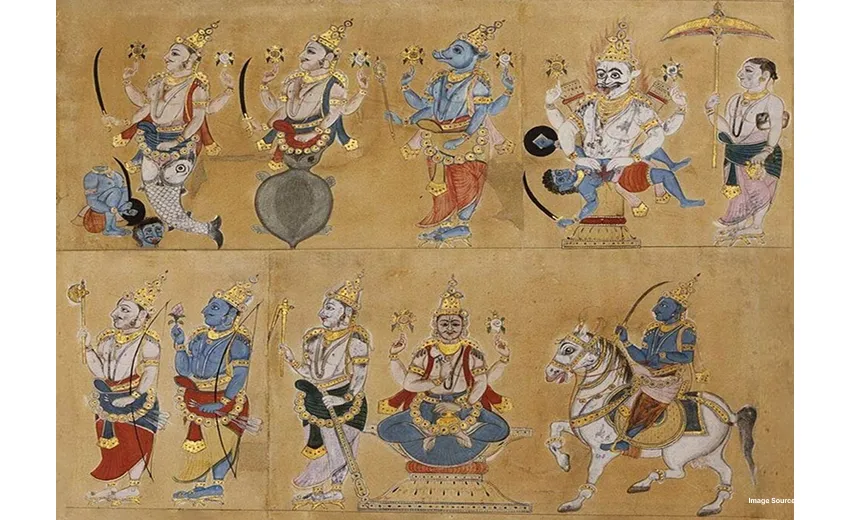
Whenever the world is in trouble and loses balance, ancient Indian belief teaches that a higher force takes form to rescue and restore it. Lord Vishnu,the preserver, does this in ten different physical forms, known as the Dashavatara.
|
|
|
|
|
|---|---|---|---|
|
|
|
|
|
|
|
|
|
|
|
|
|
|
|
|
|
|
|
|
|
|
|
|
|
|
|
|
|
|
|
|
|
|
|
|
|
|
|
|
|
|
|
|
|
|
|
|
|
|
This is the most striking part. The sequence — aquatic life → amphibious → land animal → part-animal/part-human → human — mirrors Darwin's theory of evolution almost exactly, written thousands of years before Darwin. This progression moves from water life to land life to humans. It closely matches the idea of evolution, described long before modern science explained it. Lord Buddha is one of the most globally known forms of Lord Vishnu, responsible for enlighting world with peace. The final form, Kalki, is yet to come, the one who will end the Kaliyug, the current age.
TL;DR: The ten avatars of Vishnu in Indian myths follow a progression from sea creature to land animal to human that lines up almost exactly with what Darwin later called evolution.
Shesha Naga — The Serpent Beneath the World
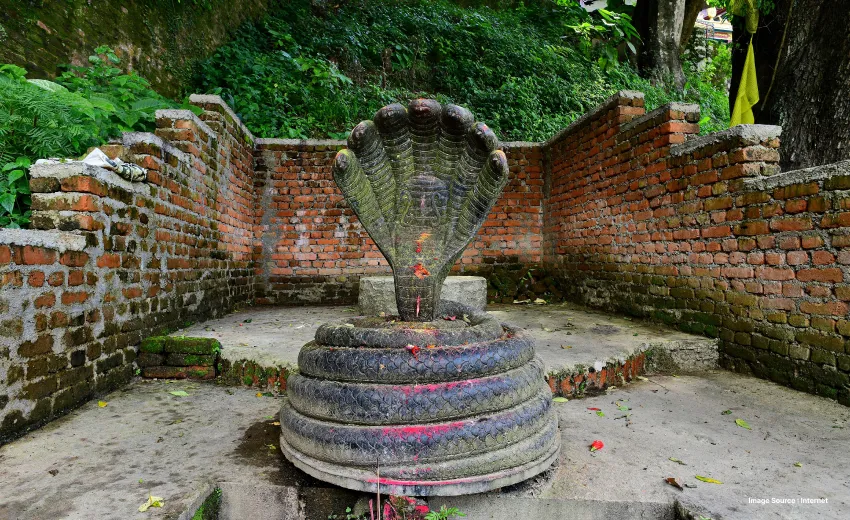
In ancient Indian texts, a great cosmic serpent called Shesha Naga is mentioned , also known as Ananta, meaning “endless” or infinite. He is said to have multiple hoods and exists beneath the world, supporting all of creation on his many hoods. Lord Vishnu himself is often depicted resting on Shesha , a metaphorical representation of preserver resting on the infinite foundation of existence. Whenever Shesha shifts or moves, the earth above him trembles, causing earthquakes.
At first, this may sound symbolic, but it reflects a deeper observation. The ground we live on is not still. The Indian subcontinent sits on a massive tectonic plate that is constantly moving, slowly pushing into the Asian plate. This movement is what formed the Himalayas and continues to cause earthquakes in the region even today.
The idea of a powerful, unseen force beneath the earth that occasionally shifts and affects everything above it is not far from this reality. identical to tectonic plates, Shesha is not just a physical being but represents the underlying energy that holds existence together.
Vishkanyas — Women Trained as Living Weapons
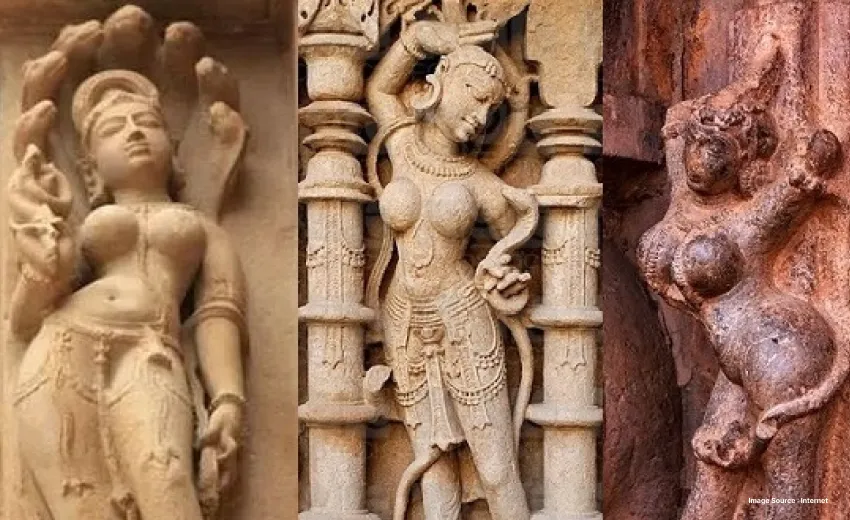
This is one of the lesser-known but very real aspects of ancient Indian political knowledge. The term Vishkanya literally means “poison maiden.” These were women who, according to ancient texts, were trained from a young age to build immunity to poison and were later used in political missions.
This concept comes from the Arthashastra, a detailed manual on governance and strategy written around 300 BCE by Kautilya, also known as Chanakya. It was not a religious text but a practical guide used during the Maurya Empire, one of the largest and most powerful empires in ancient India.
The Arthashastra covers everything from administration and economics to espionage and warfare. The mention of Vishkanyas shows how advanced and realistic this system was. It did not ignore the darker side of power. Instead, it acknowledged that politics often involves difficult and morally complex decisions.
The Ramayana — The Story of the Ideal Human Being
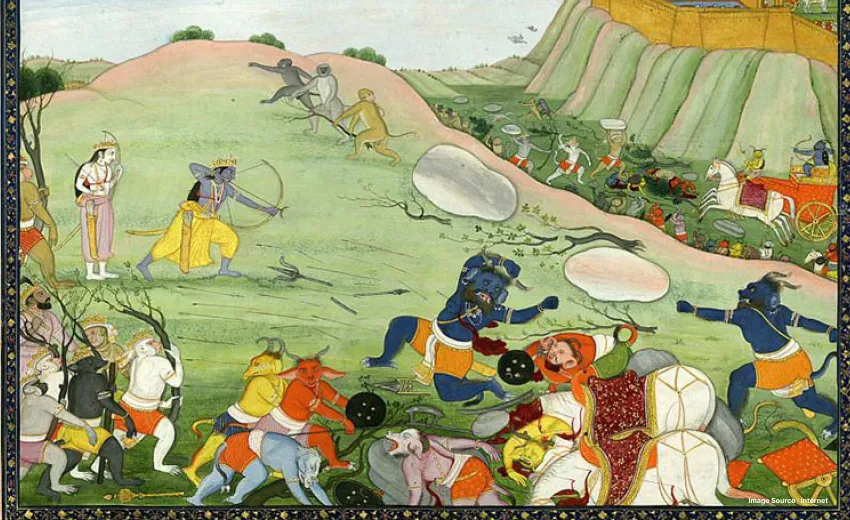
The Ramayana is not just a story, it is a learning and considered as Itihasa, meaning history or “this is what happened.” It follows the life of Lord Rama, one of the forms of Lord Vishnu from the Dashavatars, a prince of the kingdom of Ayodhya, exiled for 14 years with his wife Sita. During this time, Sita is taken by Ravana, the demon king of Lanka, who is described as highly learned, a master of the Vedas, a devotee of Lord Shiva, and the ruler of a powerful kingdom. His strength and knowledge was unmatched even by gods(Devas), which makes Lord Rama’s victory not just a rescue, but a moment where dharma overcomes Darkness and Evil.
A key part of the Ramayana is the construction of Ram Setu, a bridge built by Rama’s army of monkeys with floating stones across the ocean to reach Lanka. Today, a chain of limestone shoals between India and Sri Lanka, visible in satellite images, is often identified with this bridge. Lord Hanuman also plays a major role, helping locate Sita and supporting the mission with strength, loyalty, and devotion.
Rama is remembered for his character as much as his victory. He accepted exile without resistance to honor his father’s word and remained steady in duty, truth, and discipline throughout his life. He is seen as the ideal human being, prioritizing responsibility over personal comfort. His return to Ayodhya after victory in the sacred war is celebrated as Diwali, marking the victory of good over evil. Places linked to the Ramayana, such as Ayodhya and Rameswaram, still exist today in India as active centers of belief and pilgrimage, keeping the tradition alive in daily life.
The Mahabharata — The Greatest War Of All Time
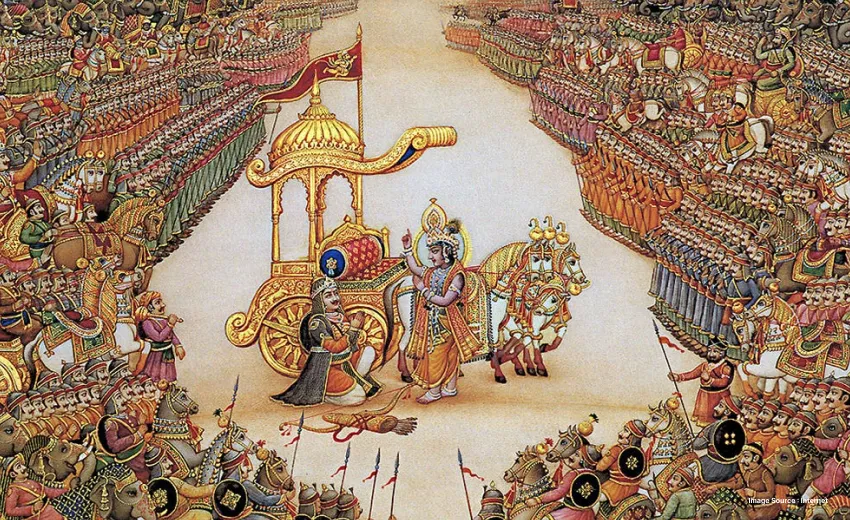
The Mahabharata is the longest epic ever written, far larger than any other ancient text. At its center is a great war between two sides of the same royal family—the Pandavas and the Kauravas. This battle takes place in Kurukshetra, a real location in present-day India.
One of the most important parts of the Mahabharata is the Bhagavad Gita. It is a conversation between Arjuna, a warrior, and Lord Krishna, just before the battle begins. Arjuna is confused and unsure about fighting his own family. Krishna guides him, explaining duty, purpose, and the nature of life itself.
The Mahabharata is not just about war. It deals with real human problems—confusion, responsibility, right and wrong. The city of Dwarka, described as Krishna’s kingdom, has been found underwater near the coast of Gujarat, matching the description of its submergence in the text. This connects the epic to real locations and strengthens its place as preserved history.
Karma and Rebirth — The Soul’s Long Journey
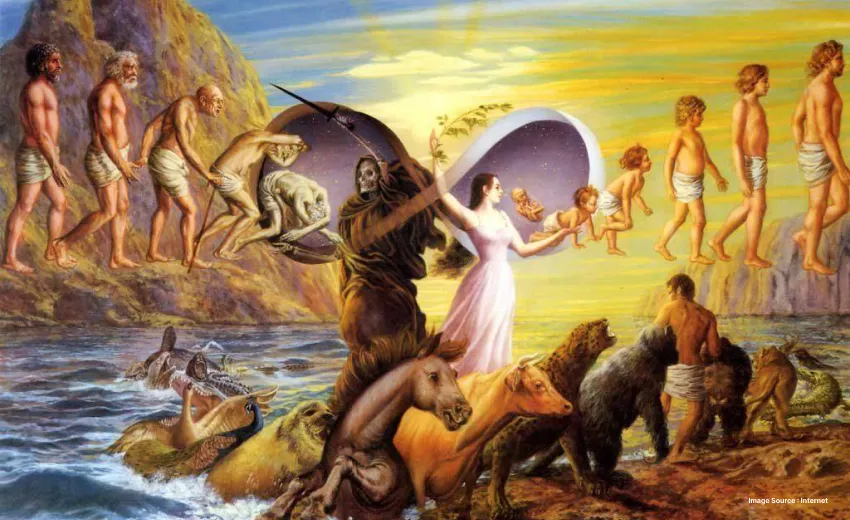
Karma is one of the most widely known ideas from Indian thought, but it is often misunderstood. It does not simply mean “what goes around comes around.” It means that every action has a result, and that result stays connected to the person who created it.
Not all results are immediate. Some take time. Some may even carry forward into another life. According to this belief, the soul does not live just once. It goes through a cycle of birth, death, and rebirth called Samsara.
Over time, the soul learns and evolves through its experiences. The ultimate goal is Moksha, which means freedom from this cycle. This idea explains why life can seem unfair if viewed in a single lifetime, because the full picture extends beyond just one life.
Triloka — The Three Worlds
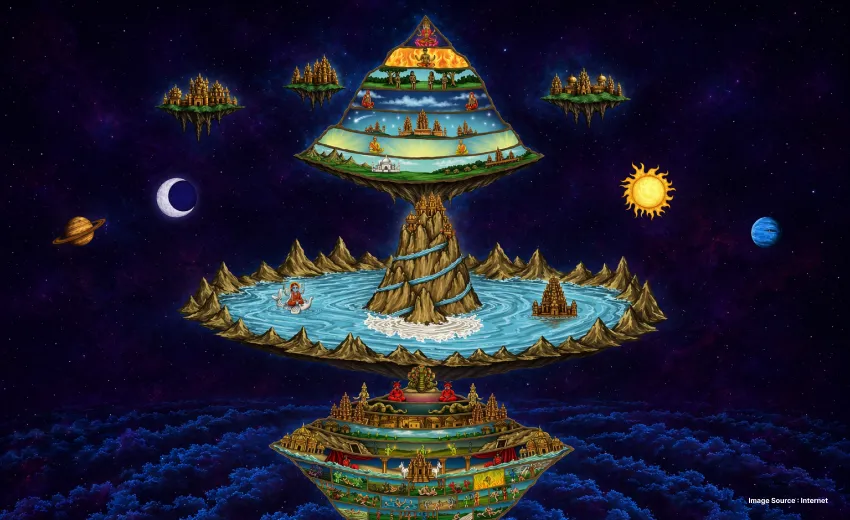
Ancient Indian belief describes existence as having three main levels, known as Triloka. These are Swarga (the higher realms), Bhu (the earthly world where humans live), and Patala (the lower realms).
These are not simply imaginary places. They represent different levels of existence and different states of being. The soul moves between these levels depending on its actions, awareness, and growth.
This way of organizing existence shows a structured and layered understanding of reality. It comes from a civilization that also developed important mathematical ideas like zero and the decimal system, showing that its thinking was both philosophical and systematic.
Kali Yuga — The Age We Are Living In Right Now
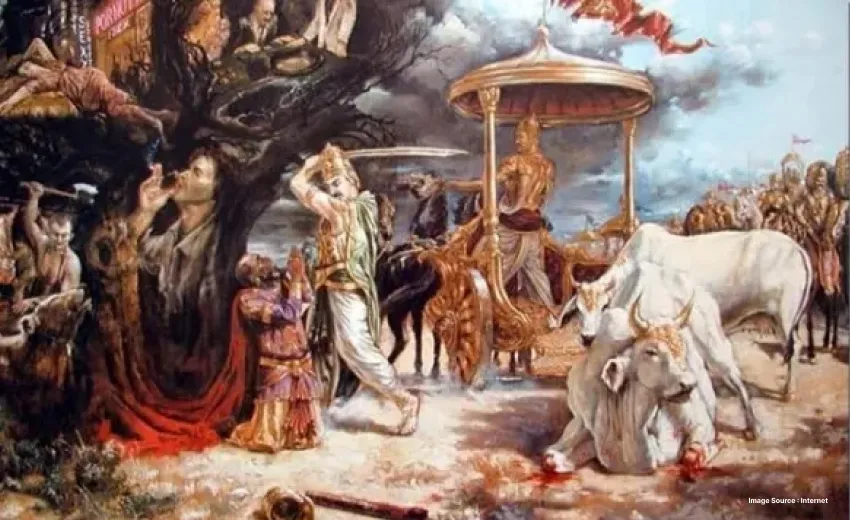
Ancient Indian thought divides time into four repeating ages, known as Yugas. Each age becomes more difficult and less stable than the one before it. According to this system, we are currently in Kali Yuga, the final and most challenging age.
This age is described as a time when truth becomes harder to recognize, leaders become less responsible, and society begins to lose balance. These descriptions feel very familiar even today.
However, this is not a hopeless view of time. After the Kali Yuga ends, the cycle begins again with a new and better age. Time is not seen as a straight line with an end, but as a cycle that keeps renewing itself.
TL;DR: Ancient Indian texts named the age we are all living in right now, described it as a time of confusion, broken leadership, and lost truth.
Every entry in this list comes from a real text, a real place, or a belief that is still followed today. These are not lost or imaginary stories. They are part of a living tradition that continues to shape how people understand life, time, and existence. Understanding them starts with looking at them with attention, not dismissal.
Frequently Asked Questions
1. Are Indian Myths the same as Indian religion?
Not exactly. What are called the Indian myths form the historical and philosophical base of Hinduism. These accounts are understood as real within that tradition.
2. Why do these Indian myths feel so different from Greek or Roman mythology?
Because they were not treated as fiction in their own tradition. Texts like the Ramayana and Mahabharata are considered Itihasa, meaning recorded events.
3. Can someone appreciate Indian myths without being Hindu?
Yes. These ideas are studied and respected around the world for their insight into life and human behavior.
Plan your bespoke india journey today
tell us what inspires you - and we will handcraft an experience that mirrors your elegance, pace & personality.
START PLANNINGTrending Travel Stories
Stay inspired with our most popular travel stories, practical advice, and must-read destination guides.

The Camping Gear Guide

Sea to Summit dry bag

Backpacking Sleeping Pad

Top 6 Places to Travel in December
The Richest Indian Tradition
Discover the Taste of North India
.webp)
Namstey! From India
Visit Rome vs. Rajasthan
TRAVELOSEI PROMISE
What To Expect?

The Real India,
Re-Imagined For You
India is not just a destination - it's a world with-in the world. TRAVELOSEI go far beyond guide-books to offer you an India that is authentic yet exclusive, spiritual yet sophisticated delivered through private doors, rare access, and impeccable attention to details.

Trusted By Global Elites
From World Class Leaders to Forbes Listed Families and international Royalties to
visionary CEOS.
Our clientele chooses us for one reason - We Know India. Over two decades of providing
experiences which aren't just luxurious - they are intimate, curated & wildly rare.

Bespoke Travel Experience
For those who seek truth in detail, art in hospitality, and identity in experience. Our Luxury Travel Architect work discreetly and personally with you to craft travel experiences that go beyond 5 Stars, where every detail whispers luxury - and legacy.

White-Glove Concierge
24 X 7 Dedicated Concierge Support even in the wildest corners of India. At TRAVELOSEI, our concierge team ensures that everything-from airport- tarmac pick-ups, last minute reservations and private spiritual sessions - is handled before you even ask.


