
Last Updated : Jul 03, 2026 | Author : Tia | View Count : 195 | Read Time : 6 min
Backpacking Sleeping Pad Guide: The Ultimate Guide to Choosing the Right One
Before leaving the house for an adventure holiday, we all keep our passports, wallets, and locks on hand. Prioritising security and safety before comfort. Travelers more often than not forget to prioritise the most important tool in their toolkit for a good day’s travel, and that’s sleep. To optimize the amount we spend on accommodations, we tend not to care about where we sleep. This might sound familiar to you: waking up cold, sore, or even exhausted. A good night’s sleep determines whether you wake up feeling refreshed or worse than the night before. This guide will walk you through everything you need to know before you choose yet alone start using a backpacking sleeping pad on your next trip!
Are backpacking sleeping pads good for travel?
Yes, these are great for travel as they are compact and make sleeping on hard surfaces like the ground easier and prevent dirt from entering your sleeping areas whilst you’re on the road.
What is a Backpacking Sleeping Pad and Why Does it Matter
The backpacking sleeping pad is a lightweight, packable cushion that goes between you and the ground when you’re sleeping outdoors. This is ideal for camping or trekking in any place where finding a reliable bed to spend the night is not possible. These pads have 2 main functions, the first being insulating your body; the pad keeps your body warmer faster than normal. This process is called conductive heat. Without a pad, even on a warm night, direct contact with the ground can lead to a chilling feeling throughout your body.
This pad also goes beyond just heating your body, but rather cushions your body against roots, rocks, and uneven terrain. This ensures your safety avoids you from getting pricked or injured by something surrounding you, especially after a full day of hiking. When you skip getting one of these pads, it’ll surprise you how fast your trips get cut short.
Types of Backpacking Sleeping Pads (Foam, Inflatable, Self-Inflating)
All of these sleeping pads don’t work the same way, and picking the right type of pad depends on your personal priorities and needs; this could include, but is not limited to, weight, comfort, durability, or even budget.
Let’s start off talking about foam pads. These are simple closed-cell foam sheets, often the most affordable option out of the lot, and they often require no setup whatsoever and are good to go as they are. All you have to do is take one end of the foam pad and unroll it as you go. The tradeoff for this, on the other hand, is that it’s quite bulky, so these aren’t as easy to stuff into smaller backpacks.
Then you’ve got inflatable pads; these often use chambers that open up manually, or you can even use a pump sack like a bicycle pump, for example. In contrast to the foam pads, these are quite compact in nature, and they’re able to inflate and deflate easily, but you need to be mindful of this because it could lead to punctures.
Lastly, you have the self-inflating pads. These are also coated with cell foam, and they open with an air valve; the valve expands and draws in the air, and it doesn’t require any manual pumping per se. This offers you the best balance of comfort as well as reliability; however, these are heavier than the inflatable pads, so it’s important to consider what type of pad you’re taking on what trip, and be cautious of the size, as for more compact journeys, inflatable pads would be the way to go.
TL;DR: backpacking sleeping pads come in 3 types: foam pads, inflatable pads, and self-inflating pads.
R-Value Explained: Choosing Warmth for Every Season
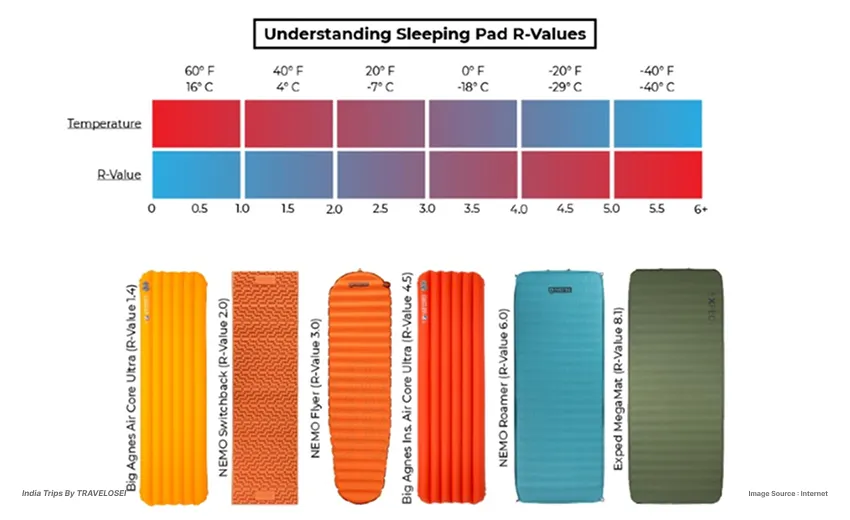
The next thing to consider is the R-value, which refers to resistance. The higher the R number is, the more resistance the pad provides. R values 1-3 are suited for warm summer trips; something around R values 3-5 would be better suited for solid all-range weather conditions, such as spring, fall, or mild winter conditions. Anything that’s above a 5 is built well for winter camping or snow travel seasons where ground temperatures drop well below freezing.
The best R rating falls right in the middle, with the pad at about a 4. This ensures that there’s flexibility in the design of the pad without compromising on the amount of weight that it can support. Certain brands also offer combo setups; these usually pair a lightweight pad and add a foam pad underneath this initial pad to boost the R-Value, and these setups are ideal for colder trips.
Types of backpacking Sleeping Pads for Different Travel Styles
As with anything related to traveling, it’s about tailoring your equipment to your needs. Here, we’ll discuss some of the ideal backpacking sleeping pads and situations in which they’d be ideal and useful. Starting with the Nemo Tensor All Season Ultralight Insulated, this is lightweight, comfortable, and compact, and, most importantly, well insulated, ideal for campers. Next, we have the Klymit Static V Base. This is also comfortable but only costs a fraction of the price of other pads, due to its lack of insulation. These are ideal for summer hiking adventures. Our next recommendation would be the Therm-aREST NeoLoft. This has a slightly thicker pad and can be a lot heavier than the other 2, but it’s worth the splurge if you’re going up the mountains.
So the key is to pick up something that’ll suit the weather conditions that you need to take into account whilst packing for your trip. Think about things like where you plan on staying, what you’re going to be doing all day, and absolutely take into consideration the climate of the situation that you’ll be working in.
How to Set Up and Sleep Comfortably in Any Location

There are several factors to take into account when you’re choosing where to set up the pad; a few extra minutes of mindful thinking can yield a night of solid rest. Make sure to scout the site before setting up the tent. Make sure there aren’t any rocks near the campsite, roots, or pinecones. Make sure to scuff away any small pebbles with your feet. If the ground isn’t perfectly flat, then always position yourself at an angle where your head is slightly higher than your feet. This prevents blood from rushing to your head overnight.
Make sure the pad is soft. A lot of people are under the assumption that a firm pad is best and the most durable, but a softer pad clenches your hips and shoulders much more naturally. Make sure you check on everything and do all your maintenance clearances before settling in for the night. Keep in mind the temperature throughout the night and adjust to your comfort accordingly by letting some of the air out of the pad for a softer, less firm surface. All of these steps will ensure comfortable, soothing sleep on your long trails.
Maintenance and Repair Tips to Keep It Travel-Ready
This is a one-time purchase, and with the right care and maintenance, it can last for decades. A little maintenance can go a long way. Firstly, always wipe down the surface with mild soap, check for any dirt, sweat, or oils that can threaten to degrade the material over time, and let the material completely dry before storing it. Pad materials benefit from an occasional waterproofing treatment. Check seams, valves, and the surface for small nicks or weak spots before you leave. When you catch these issues ahead of you’re not surprised on the day of the trip itself.
Dirt, sand, and moisture can build up in valves over time, causing slow leaks that are hard to diagnose. Wipe valves clean after dusty or sandy trips. If your pad is losing air, submerge it in water (like a lake or a filled sink) and look for bubbles or listen closely in a quiet spot. Mark the spot immediately so you don't lose track of it.
All of these precautions lead to a safer, more comfortable journey and are good to keep in mind before you take your next trip.
Your Next Read: Find The Best Carry On Luggage for International Travel
FAQs
1. What's the difference between R-value and thickness?
R-value measures insulation (how well the pad blocks cold from the ground), while thickness affects comfort and cushioning.
2. Foam, air, or self-inflating: which should I choose?
Foam pads are the most durable and puncture-proof but bulkier and less comfortable.
3. How do I prevent punctures on the trail?
Clear your tent site of sharp debris before laying down your pad, use a footprint or ground tarp underneath, and keep a repair kit.
Plan your bespoke india journey today
tell us what inspires you - and we will handcraft an experience that mirrors your elegance, pace & personality.
START PLANNINGBlogs Categories
It is a Sanskrit verse taken from an ancient Bharat (Indian) scripture
which means ‘The Guest is like God’.
In Bharat (India), guests are always welcomed with open arms and given

WANDER INDIA
Your go-to guide for exploring the best of India.

FESTIVALS OF INDIA
Festive Flavours

INDIAN HERITAGE
An enticing showcase of India’s glorious 5,000 year old history & heritage.

SACRED SPIRITUAL JOURNEYS
Discover what gives India the mystics that the world adores

TRAVEL TALES
Make the simplest of journeys unforgettable with hidden gems tours & extravagant stays.
You Will Like These Too...
It is a Sanskrit verse taken from an ancient Bharat (Indian) scripture
which means ‘The Guest is like God’.
In Bharat (India), guests are always welcomed with open arms and given








TRAVELOSEI PROMISE
What To Expect?

The Real India,
Re-Imagined For You
India is not just a destination - it's a world with-in the world. TRAVELOSEI go far beyond guide-books to offer you an India that is authentic yet exclusive, spiritual yet sophisticated delivered through private doors, rare access, and impeccable attention to details.

Trusted By Global Elites
From World Class Leaders to Forbes Listed Families and international Royalties to
visionary CEOS.
Our clientele chooses us for one reason - We Know India. Over two decades of providing
experiences which aren't just luxurious - they are intimate, curated & wildly rare.

Bespoke Travel Experience
For those who seek truth in detail, art in hospitality, and identity in experience. Our Luxury Travel Architect work discreetly and personally with you to craft travel experiences that go beyond 5 Stars, where every detail whispers luxury - and legacy.

White-Glove Concierge
24 X 7 Dedicated Concierge Support even in the wildest corners of India. At TRAVELOSEI, our concierge team ensures that everything-from airport- tarmac pick-ups, last minute reservations and private spiritual sessions - is handled before you even ask.


